 1 1
Pre-1870 John C. Heenan CDV by Fredricks. This is the earliest verifiable boxing card. Until the late 1850's the photographic technology did not permit commercial scale, affordable production of photographs. Fredricks was one of the first to make albumen images, a skill he learned in France and brought to the States in 1855. By the time this card was issued as part of his commercially produced "Specialite" series of famous personages, Fredricks owned a large studio and gallery in New York City. His work is featured in a number of museum collections, including the Smithsonian.
|  2 2
N167 Jem Carney. One of four cards issued as part of N167 by Goodwin, it is the first series of boxing cards inserted into packages of cigarettes.
|  3 3
1887 N28 Allen & Ginter Jimmy Carney. N28 cards are the most common of the 19th Century tobacco boxing cards and among the easiest to collect in high grade (ex or better) because they are printed on thick, high quality cardboard. The set consists of 50 cards, ten of which depict boxers. On the card backs is a checklist of the issue.
|  4 4
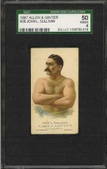
The great John L. Sullivan's N28 card. I feel it is his finest representation on a 19th century lithographic card.
|  5 5
N29 Jack McGee. Following the success of the N28 series of fifty cards, Allen & Ginter issued a second series, which Burdick dubbed N29. We know it is a second series because it says so right on the card backs. N29 cards are more difficult to find than N28 cards but still readily collected.
|  6 6
N29 Allen & Ginter Patsey Kerrigan.
|  7 7
N43 Frank Murphy. Acting on the old adage that more of a good thing is better, Allen & Ginter re-used the images of the N29 set to create the set that Burdick catalogued as N43. The set features the fronts of the N29 cards within oversized cards that depict colorful boxing and decorative paraphernalia alongside. These cards are large, even bigger than modern cards, and were used in 20-packs of cigarettes, as stated on the card reverses. They are in very high demand.
|
 8 8
This is an album page from the 2nd series of Allen & Ginter champions albums, ACC designation A18.
|  9 9
Here is a proof of wrestler Theo Bauer from the N28 set.
|  10 10
N162 Old Judge & Gypsy Queen Charlie Mitchell. There are five boxers in this colorful and extremely popular multisport lithograph set from Goodwin: Jack Dempsey, John L. Sullivan, Jake Kilrain, Jem Smith and Charlie Mitchell. All five are IBHOF members. The card backs contain a checklist. N162’s are moderately difficult but not rare.
|  11 11
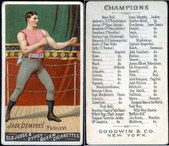
N162 Old Judge & Gypsy Queen Jack Dempsey.
No, this is not the heavyweight champ. This is the original Jack Dempsey, a great middleweight champ nicknamed the Nonpariel. The other fellow is William Harrison Dempsey. He took the name in tribute to the Nonpariel and it stuck.
|  12 12
N174 Jack Dempsey. The second major boxing issue from Goodwin consists of albumen photographs in nine formats; the set is very complex. Cards with the rectangular bottom logo are sometimes found with a distinctly pink hue. I have no idea nor, frankly, does anyone else, whether only certain boxers have cards in certain styles, and to state otherwise is to speculate. I have a comprehensive checklist in my book but new variations do surface. N174 cards sell for high prices when they are found.
|  13 13
N174 Gypsy Queen Tug Wilson. Issued only with two formats, GQs are scarcer than OJs. The thick-skulled Wilson came to the US from England, stood in with Sullivan for long enough to win a $1,000 challenge purse for lasting, and returned to England to open a grocery business with the money.
|  14 14
N174 Peter Jackson. This format of N174 has the pink cards. Jackson was the best of the 19th century black heavyweight contenders, denied a shot by Sullivan. He and Corbett fought to a draw.
|
 15 15
N174 George Godfrey. He is misidentified as "Joe" Godfrey. The most common format N174. Godfrey was another black contender. This and the Peter Jackson are the earliest known cards of black boxers, so they bring a premium from specialists. Godfrey was elected to the Bare Knuckles Boxing HOF.
|  16 16
|  17 17
A John Wood cabinet card of Godfrey from the same photo session as the Old Judge card's photo. Cabinet cards were populaly issued in the late 19th and early 20th centuries. They are called “cabinet” card or “premium” card because their size usually exceeds 4” x 6” and were often displayed in curio cabinets. Many were issued to promote various organizations and businesses. Some were even issued by boxers to promote themselves, or sold individually by companies capitalizing on the card collecting craze to sell mass-produced images of celebrities.
|  18 18
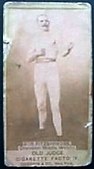
N174 Bob Fitzsimmons. Sorry for the lousy scan but this card is rare and was issued in Australia.
|  19 19
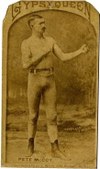
N174 large screen Gypsy Queen. There are 7 known cards with the large GQ legend with only 1 example of each fighter known.
|  20 20
N174 large screen Gypsy Queen Willie Clark.
|  21 21
Old Judge card with rare back advertising, likely an Australian or UK issue.
|
 22 22
A very rare Aussie OJ card
|  23 23
|  24 24
1887 W.S. Kimball Champions of Games and Sports (N184)Patsy Cardiff. Not to be outdone by its competitors at Allen & Ginter and Goodwin, W. S. Kimball & Co. issued its own set of champions cards. There are five boxers. The card fronts are found with or without the company name wrapped around the portrait of the subject.
|  25 25
N184 John L. Sullivan, with logo around the head. These are the rarest of the regular tobacco sized multisport champions lithographed issues and owing to thin borders and weak cardboard are very hard to find in nice shape.
|  26 26
|  27 27
|  28 28
N150 John L. Sullivan. One of four poses found in the issue.
|
 29 29
|  30 30
|  31 31
|  32 32
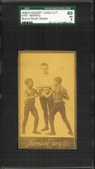
N157 The Sunny South. Boxer is Cal McCarthy an early featherweight and bantamweight champ
|  33 33
N692 a smaller, tougher version of N157 w/ different branding
|  34 34
|  35 35
|
 36 36
1889 Kinney Hold To The Light Metamorphic (N223)John L. Sullivan. This is a unique, extremely rare issue. The cards’ images change when held to sunlight. The Sullivan, gets long hair and a beard when he changes. It is a layered set of images on thin stock and is vulnerable to damage.
|  37 37
1889 S.F. Hess & Co. (N332) Jack Havlin. S.F. Hess, a Rochester, NY company, issued a very rare series consisting of an unknown number of blank-backed photographic cards of boxers and other celebrities in a format very similar to N174. The issue is so rare that it is meaningless to speak of the 80+ known cards as a set.
|  38 38
N332 S.F. Hess Charlie Mitchell. It was not uncommon for parents to lop off the tobacco ads on cards and give the images to their kids. When the card is rare it can make identification a challenge. This one was sold as an unidentified photo of an anonymous boxer and sold for less than 1% of what a Hess would normally cost.
|  39 39
|  40 40
1887 Lorillard’s Mechanics Delight (N269) Jimmy Elliot. Lorillard issued this sought after set of fifty numbered boxing cards in 1887. Personally, my favorite 19th century set; I appreciate the broad scope of subjects, the numbering, and the write ups on the backs of the cards.
|  41 41
N269 Lorillard Mechanics Delight Tommy Warren. An early lightweight champion.
|  42 42
N269 Lorillard Mechanics Delight John L. Sullivan. One of two Sullivans in the set, both carrying the same card number.
|
 43 43
N269 Lorillard Mechanics Delight Bill Poole. A gangster and nativist political enforcer immortalized in Herbert Asbury's "The Gangs of New York" who was drawn on to create the "Butcher Bill" character in the movie. Murdered by Irish gangsters affiliated with John Morrissey (our next card subject), his last words were "I die a true American." His funeral procession drew thousands of onlookers.
|  44 44
John "Old Smoke" Morrissey. The Tammany politico and gangster was one of the toughest bare knuckles brawlers of pre-Civil War NYC and founded the Saratoga Springs track. Served in Congress and died a very wealthy man. His crew murdered Bill Poole, though not on his orders. He and Poole had a bitter blood feud based on Poole's nativist sentiments.
|  45 45
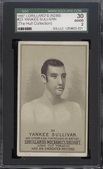
Yankee Sullivan was another heavyweight/criminal. Allegedly killed himself in jail in San Francisco awaiting trial but it was the time of the Vigilance Committee and it may have been an 'assisted' suicide.
|  46 46
1889 History of Poor Boys and Other Famous People (N79) Jake Kilrain: Although not really cards, the two booklets in this series that depict boxers are popularly collected by 19th century boxing card collectors. The booklets were produced by Duke and show various Duke products in addition to detailed biographies of the celebrity subjects. The elaborate cover art is what makes these items popular among collectors. The two boxer subjects are John L. Sullivan and Jake Kilrain. The set is popularly treated as an 1888 issue, but that is clearly wrong; the last paragraph of the Kilrain biography states that he and Sullivan had signed in January 1889 for a July 1889 championship bout.
|  47 47
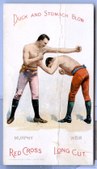
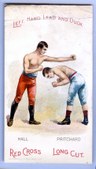
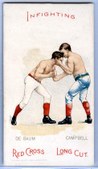
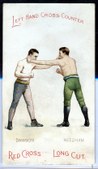
1893 Lorillard Red Cross Long Cut Tobacco (N266)Choyinski[sic] and Goddard. The set designated N266 by Burdick consists of 25 known unnumbered cards. It is one of the easiest sets to date; 1893 is printed right on the fronts of the cards in very small, faint print below the “Red Cross” name. Each oversized “tall boy” card depicts a match between two fighters and illustrates a specific move. Some of the illustrations show blows permitted under the rules of the London Prize Ring (“L.P.R.”), but not under the modern rules for gloved prize fights. Card backs contain a short blurb about the fighters and fight depicted, and a huge Red Cross advertisement. These colorful cards are larger than average tobacco cards but smaller than postcards, trade cards or cabinet cards, which accounts for both their desirability and their difficulty in better conditions.
|  48 48
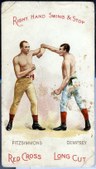
N266 Fitzsimmons v. Dempsey. One of the two keys to the set showing Jack Dempsey and Bob Fitzsimmons, who fought for the middleweight crown. Fitz held two titles at once (middle and heavy) at a time when there were only three weight divisions.
|  49 49
N266 Murphy v. Weir
|
 50 50
N266 McAuliffe v. Myers
|  51 51
N266 Hall v. Pritchard
|  52 52
N266 Frazier and Daly
|  53 53
N266 De Baum and Campbell
|  54 54
N266 Dawson and Needham
|  55 55
N266 Chambers and Clark
|  56 56
Offered for sale the few times they've come up as some prototype, they are much more likely cuts from some sort of as yet undiscovered poster for the Red Cross set.
|
 57 57
|  58 58
1895 Mayo Cut Plug (N310)Joe Chonskia [sic]. Mayo produced a series of 35 subjects with photographic depictions of many of the biggest stars of the day. The set features two front styles: names at the top and names at the bottom of the image.
The fighter whose name was routinely mangled by the card companies, San Francisco native Joseph Bartlett Choynski [ko-yin-ski] was the first great Jewish-American fighter. Although he weighed about 170 he was a heavyweight who fought most every contender and champion, and defeated Jack Johnson early in Johnson's career.
|  59 59
Mayo Jim Corbett, name at bottom variation.
|  60 60
Mayo Jim Hall. There are extreme print variations found in the name at bottom Mayo issue. They are detailed in my book. Ones like this, missing the artistic enhancements, are the rarest.
|  61 61
Side by side of a fully finished Hall card and one missing the art layers.
|  62 62
N310 Joe Walcott
|  63 63
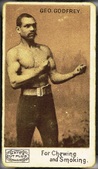
Old Chocolate Godfrey, name at bottom variety.
|
 64 64
2012 HOFer [finally] Jake Kilrain, name at bottom variation
|  65 65
Another uncut N310 strip
|  66 66
All three of the N310 uncut strips shown here originally fit together as one strip but were separated over time. I know of only one other uncut N310 strip.
|  67 67
|  68 68
|  69 69
|  70 70
N386 Spaulding & Merrick John L. Sullivan
|
 71 71
This is a carte de viste (CDV) of Jem Carney. About the size of a modern photograph it was produced in the 1890s.
|  72 72
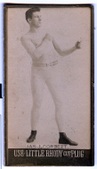
N537 Little Rhody Jim Corbett
|  73 73
|  74 74
|  75 75
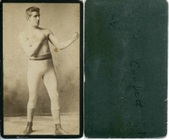
1890s Jim Corbett CDV.
|  76 76
Richard K. Fox, publisher of the Police Gazette, was a well known photographer and prize fight promoter. He was responsible for a large issue of cabinet cards under his own studio name as well as a set issued under the Police Gazette name. He also made up several CDVs of himself, like this one.
|  77 77
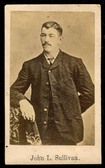
A CDV of The Great John L in his prime, from the UK.
|
 78 78
Richard K. Fox cabinet of Bob Fitzsimmons.
|  79 79
Another Fox cabinet of Bob Fitzsimmons, this one on a rare white mount.
|  80 80
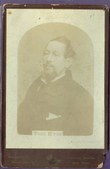
Richard K. Fox cabinet Tom Hyer. Hyer was one of the first American heavyweight champs, winning acclaim in a 101 round (yes, that is correct) bare knuckles title fight in the 1840s. He successfully defended against Yankee Sullivan in the 1851 and then retired to run his bar and gang in New York City.
|  81 81
|  82 82
|  83 83
|  84 84
|
 85 85
|  86 86
|  87 87
|  88 88
|  89 89
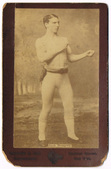
This cabinet of HOFer Charlie Mitchell was issued as part of a set of boxers by The Champion and is designated in the ACC as M125.
|  90 90
M125 cabinet of Australian boxer Frank Slavin.
|  91 91
Police Gazette John L. Sullivan. Richard Fox issued a multitude of cabinet cards under his studio and also issued a series for his newspaper The Police Gazette. The latter have the ACC designation M128.
|
 92 92
M128 Jake Kilrain
|  93 93
John Wood Studio cabinet card of Jack [Nonpariel] Dempsey. An image from the same sitting was used to make his S.F. Hess card.
|  94 94
Jem Smith. Same pose as used on the N167 Old Judge and N151 Duke Honest Long Cut cards.
|  95 95
Patsy Cardiff. Same pose as his Old Judge card.
|  96 96
Jake Kilrain by Wood. Same pose as his N174 Old Judge.
|  97 97
Stevengraph silks of Kilrain and Smith. An English issue of four cabinet-cards that frame very finely woven silk fighter portraits about the size of a bank check.
|  98 98
|
 99 99
1895 Newsboy Cabinets (N566)Peter Jackson. The National Tobacco Works issued a gigantic set of several hundred cabinet (4 1/4” x 6 1/2”) cards in the early 1890’s, popularly listed as an 1895 issue. I know of 4 boxing subjects, John L. Sullivan, Jim Corbett, Peter Jackson and Bob Fitzsimmons, depicted on at least 14 different cards.
|  100 100
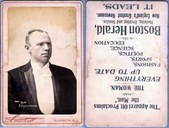
N566 Newsboy Bob Fitzsimmons with Campbell mount and Boston Herald advertisement back
|  101 101
|  102 102
N566 Corbett. One of the full body poses. Campbell mount.
|  103 103
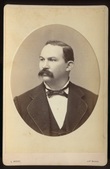
Paddy Ryan, heavyweight champ and 2020 IBHOF inductee
|  104 104
|  105 105
|
 106 106
|  107 107
|  108 108
|  109 109
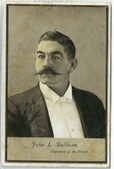
John L. Sullivan cabinet card. One of many types of souvenir cards of the first true fistic superstar, this particular format is found with at least three different poses.
|  110 110
John L. Sullivan trade card. This cabinet sized card is usually found imprinted on front or back with a local merchant's advertisement, a common use for trade cards in the late 19th century.
|  111 111
|  112 112
What we have here is somewhat of a mystery but is generally accepted as being some kind of composite sample card associated with the N150 series.
|
 113 113
|  114 114
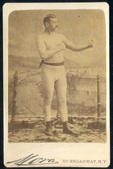
1882 John L. Sullivan cabinet by Mora. One of the earliest Sullivan cabinet issues.
|  115 115
Chickering 'borrowed' the Mora card image to make a Sullivan card.
|  116 116
|  117 117
|  118 118
|  119 119
|
 120 120
|  121 121
|  122 122
|  123 123
|  124 124
|  125 125
|  126 126
|
 127 127
|  128 128
Turning now to trade cards (product-specific issues), here is an 1890s X-Zalia Jim Corbett. A snake oil of the worst sort, Corbett plugged it for a fee.
|  129 129
This bloody card was issued with blank back or imprinted for products
|  130 130
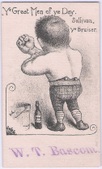
A minstrel show Sullivan toured with; very different times...
|  131 131
Sure, JL drank tea...
|  132 132
|  133 133
|
 134 134
|  135 135
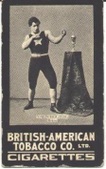
1901 Ogdens. A giant issue of several series of subjects, with a nice selection of boxers. British.
|  136 136
This is from the "A" series
|  137 137
The BAT issued different versions of the cards overseas. This was Danish.
|  138 138
Tough Aussie version of the Ogden's issue.
|  139 139
1904 Battling Nelson. Styled like a cabinet card but printed. Includes his record to 1904 on the back.
|  140 140
|
 141 141
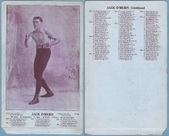
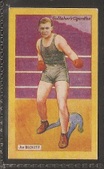
Jack O'Brien's card
|  142 142
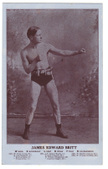
Jimmy Britt. Also seen: Jim Jeffries, John L. Sullivan
|  143 143
George Dixon, discovered in 2019
|  144 144
|  145 145
|  146 146
|  147 147
|
 148 148
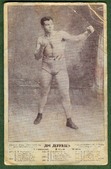
Jim Jeffries, the California Grizzly, in his prime in 1899.
|  149 149
|  150 150
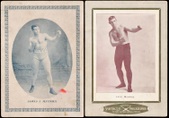
1904 Jeffries-Munroe cabinet card by Sporting Life magazine. Unlike 'true' cabinet cards, this one is printed rather than photographic, and double-sided. Only one specimen is known.
|  151 151
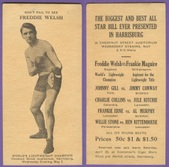
An appearance card for HOFer Freddie Welsh.
|  152 152
Dana Studios mounted photo of Monte Attell. Never seen a better Attell
|  153 153
ca.1909 James J. Jeffries self-issued cabinet card w/Sarony image. Sarony was a well-known photographer of athletes. Jeffries made several cabinets in conjunction with his 1910 comeback.
|  154 154
Spectacular mounted photo of the Michigan Wildcat, Ad Wolgast
|
 155 155
T218 Sam Langford. Perhaps the most widely collected T-type boxing cards are the T218 cards of Champion Athletes and Prizefighters, issued with various American Tobacco Company products. The T218 cards are beautiful examples of turn of the century lithography. The cards measure approximately 2 ½ x 2 7/8 inches, and typically contain a short write-up and fight statistics on the backs.
|  156 156
T218 Jack Johnson, side view. In my opinion the T218 set is the nicest looking of the 20th century lithographic sets.
|  157 157
T218 Stanley Ketchell
|  158 158
T218 Sam Langford Tolstoi back. Mecca is the most common brand of T218. Hassan is slightly more difficult to find than Mecca, say on a 55:45 ratio. The Tolstoi back is rare.
|  159 159
|  160 160
|  161 161
T218 Willie Lewis.
|
 162 162
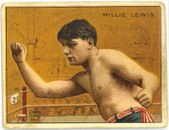
T219 Willie Lewis. The T219 set is a cut down version of T218 with only 50 boxers. Compare this card with the T218 Lewis image for the cropping. The basic cards in the set are the Honest Long Cut (“HLC”) brand cards. The Miners Extra brand is uncommon. The Red Cross brand is rarely seen.
|  163 163
|  164 164
T220 Charlie Goldman. Issued with Mecca and Tolstoi cigarettes, the 50-card set designated as T220 by Jefferson Burdick in the American Card Catalog is one of the two “basic” boxing card sets from pre-World War I era of the 20th Century.
|  165 165
T220 Silver Borders Charlie Goldman. A significant border variation exists in the T220 set. All cards are commonly found with a white border. For some reason, 26 Mecca brand cards were printed as well with a silver border.
|  166 166
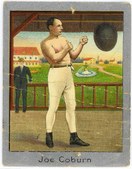
T220 Mecca Silver Borders Joe Coburn. Note the man at the left.
|  167 167
T220 Coburn white border. The man’s image clearly was removed after the silver bordered printing, since the plant leaves that replaced him still form his silhouette. Why the American Tobacco Company bothered to remove this man from the picture is unknown. It proves that the silver cards were printed first. I have never seen a white bordered Coburn with the man at the left intact.
|  168 168
T220 Silver Borders Kid Lavigne.
|
 169 169
T220 Silver Borders Mike Donovan. This card blew my mind when discovered early in 2006. Until then all catalogs carried the silver bordered variation of T220 as a 25-card subset of the 50-card issue including Jack Goodman, which does not exist. This card was the 26th silver border discovered and is one of 2 known specimens. The silver set consists of 25 cards.
|  170 170
T220 Silver Borders Young Erne
|  171 171
T220 Silver Borders Willie Beecher
|  172 172
T220 Freddie Welsh Tolstoi back
|  173 173
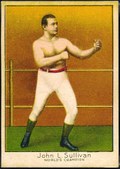
1910 Dixie Queen T223 John L. Sullivan. The same 50 cards in T220 were issued in a smaller format on coarser paper as Dixie Queen premiums. They are quite rare.
|  174 174
T224/T229 Pet/Kopec Cigarettes Monte Attell. Abe's brother Monte was a title holder. Pet and Kopec were West Coast brands with very limited distribution. Pet brand cards are rare; Kopecs are all but impossible to find.
|  175 175
T225 Jas. J. Jeffries. This series has 10 back variations. The gory details are in my book.
|
 176 176
|  177 177
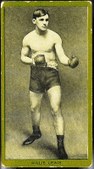
T226 Red Sun Puglistic [sic] Subjects Willie Lewis. This set of 50 cards is very tough to find and very desirable; a high grade set of 50 brought $57,605.23 at auction some years ago.
|  178 178
|  179 179
T227 Abe Attell. A multisport set of 24 known (1 missing) cards with 5 boxers issued in a large format similar to modern cards with images not seen on any other T cards, the T227 Honest Long Cut or Miners Extra brand set is very desirable, especially because of its four baseball players. Abe Attell was a Jewish-American champion who was the go-between in the 1919 Black Sox scandal.
|  180 180
T227 Ad Wolgast
|  181 181
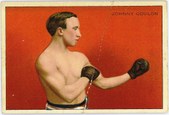
T227 Johnny Coulon. Every boxer in T227 was a champion and is in the IBHOF. The others not shown here are Frankie Klaus and Jack Johnson.
|  182 182
T227 Jack Johnson. Honest Long Cut back.
|
 183 183
T227 Jack Johnson. Miners Extra back.
|  184 184
T227 Frank Klaus. I really like this image.
|  185 185
These T227 items were cut from an as-yet undiscovered advertising piece or album. Likely an ad piece.
|  186 186
T9 Turkey Red cabinet cards are among the most beautiful cards of the T era. Commonly found with the redemption address at the bottom and on occasion with no address.
|  187 187
There is an advertising back known only with the baseball cards.
|  188 188
|  189 189
|
 190 190
|  191 191
|  192 192
1909 Jeffries Championship Souvenir Playing Cards Bob Fitzsimmons. The W.P. Jeffries Co. created a really nice set of playing cards depicting boxers and boxing matches from the past. The card back shows Jeffries, fat and happy in a bowler hat.
|  193 193
This card was enclosed in the deck of Jeffries cards and is tougher to find; I suppose it was routinely discarded.
|  194 194
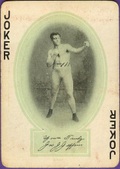
Jeff made himself the Joker.
|  195 195
Sullivan was the King; Johnson was the actual champion at the time. He does not merit an individual card, undoubtedly due to his race.
|  196 196
Another card from the set showing Jeffries about to fight Fitzsimmons for the title. The reference to bearhood is a play on one of his nicknames, the California Grizzly.
|
 197 197
|  198 198
E75 has 20 line-drawn cards issued by the American Caramel Co. The cards are checklisted on the back. It is one of the most common caramel sets.
|  199 199
E75 McCoy
|  200 200
A little tougher than E75 are the American Caramel Co.'s E76 issue, also of 20 cards with checklist backs. They can be distinguished based on typeface and fonts.
|  201 201
E76 Nelson
|  202 202
E77 Al Kaufman. Issued by the American Caramel Company, the same maker of the E75 and E76 sets, this particular set has 24 cards including two wrestlers and is very tough to find.
|  203 203
|
 204 204
E78 Frank Klaus. Cards from this set are rare. The card fronts are similar in format to the E79/80 cards, while the card backs are very similar to the E75/76 cards. There is no branding or manufacturers designation on E78 cards. A checklist of the 25 cards in the issue is provided on the card backs.
|  205 205
|  206 206
E79 Marvin Hart. E79 is one of the most widely collected boxing caramel card sets. E79 card back contain a partial checklist and reference 27 "Scrappers", giving the set its nickname. Card backs are printed in black; very rarely will be seen in red.
|  207 207
E79 red back. Some call these E80 but Burdick treated them as E79. Really, the issue is academic since they should be collected together as a two or three series single issue.
|  208 208
|  209 209
|  210 210
E79 Jack O'Brien and Partner
|
 211 211
|  212 212
|  213 213
|  214 214
|  215 215
|  216 216
E80 Attells. E80 is one of the more difficult 20th century boxing sets. E80 references 44 Scrappers on the card backs, which have a complete checklist of the set. There is overlap between E79 and E80; very likely the 79 red backs were some of the cards listed on the E80 backs.
|  217 217
Typical E80 back on a card not issued with E79
|
 218 218
Normally, this card has a lot going for it--Jack Johnson from a very difficult pre-war E set (E80). What makes this special is the stamping on the card back. I've seen this before--in a museum, when I went to research my book at the Met's Burdick Collection. The stylized "B" and the "Jeff B." indicate that this card was once the possession of none other than the creator of the American Card Catalog, Jefferson Burdick.
| 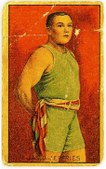 219 219
ca. 1910 Jim Jeffries uncatalogued card. A candy issue from around the time of the Johnson fight, these cards are quite difficult to find.
|  220 220
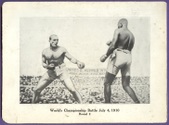
ca. 1910 New England Gum Co. Jeffries and Johnson flip card. Another Jack v. Jeff card.
|  221 221
Flip side
| 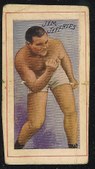 222 222
Although this strip card set uses the E79 and E95 art it is really a card cut from an advertising sheet for Philadelphia Caramel Company, which made the sets
|  223 223
|  224 224
|
 225 225
|  226 226
Heavyweight champ Tommy Burns was also a top lacrosse player. Here is his C60 card.
|  227 227
|  228 228
|  229 229
|  230 230
|  231 231
A 1913 self-issued promo card for Sam Langford, stats back shown in next image. These sorts of cards start making appearances in the 'teens.
|
 232 232
|  233 233
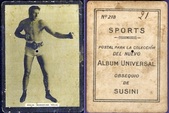
1915 Susini Jack Johnson [Cuba]
|  234 234
1915 Susini Billy Wells [Cuba]
|  235 235
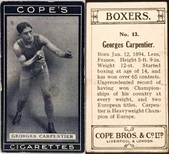
1915 Cope's Cigarettes (UK)
|  236 236
|  237 237
|  238 238
|
 239 239
|  240 240
|  241 241
|  242 242
1919 photo card of the Dempsey-Willard fight from a series of cards issued as both PCs and PC-sized blank-backed cards.
|  243 243
|  244 244
1919 Underwood & Underwood Jack Dempsey: Underwood & Underwood was known for licensing photos. Many baseball sets from the 1920’s have the U&U copyright on their images. Apparently, U&U also tried its hand at producing postcard-sized cards of its own. Dempsey and Willard are the known subjects, indicating an issue date ca. 1919.
|  245 245
1922 Comic Life Sports Champions Dempsey
|
 246 246
|  247 247
|  248 248
|  249 249
|  250 250
|  251 251
|  252 252
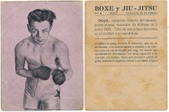
An oddball card, probably a souvenir from 1921 as there is a postcard with the same image and graphics that is dated from the Carpentier bout.
|
 253 253
|  254 254
|  255 255
|  256 256
1924 Benny Leonard standup card from the Flying Fists serial. Two known examples, one with the stand part torn off.
|  257 257
|  258 258
|  259 259
|
 260 260
|  261 261
|  262 262
1936 Indiana Sport Young Perez.
|  263 263
1936 Indiana Sport Humery-Berg, blue variation
|  264 264
|  265 265
|  266 266
|
 267 267
|  268 268
|  269 269
|  270 270
|  271 271
|  272 272
|  273 273
1926 Weber Bakery Gene Tunney. From a movie stars set. Tunney is shown from his role in The Fighting Marine.
|
 274 274
|  275 275
|  276 276
|  277 277
|  278 278
|  279 279
|  280 280
|
 281 281
|  282 282
|  283 283
|  284 284
|  285 285
|  286 286
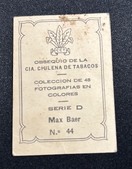
1930s Chilena de Tabacos Tunney
|  287 287
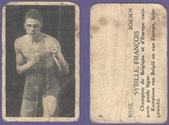
1925 Bunsen Confectionary Famous Figures Criqui
|
 288 288
|  289 289
|  290 290
|  291 291
|  292 292
|  293 293
|  294 294
|
 295 295
|  296 296
1927 York Caramel (E211) King Tut (obviously not his real name). This rare set of cards depicts fighters of the era. Burdick catalogued it as E211.
|  297 297
1927 York Caramel (E211) Frankie Genaro. The Burdick Collection at the Metropolitan Museum of Art in New York has only 2 E211 cards.
|  298 298
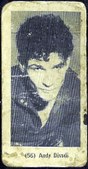
E211 York Caramel Andy Divodi.
|  299 299
1931 Cigarrera Bigott (Venezuela). Uses the York Caramel images.
|  300 300
|  301 301
|
 302 302
|  303 303
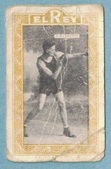
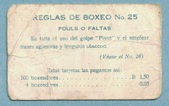
1920s Romeo y Julieta Jack Johnson. A Cuban tobacco issue of approximately 200 cards of fighters.
|  304 304
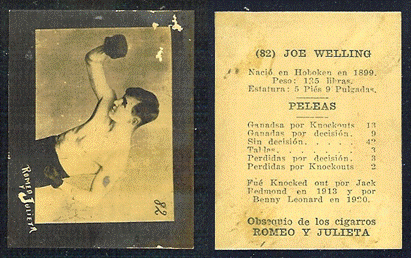
1920s Romeo y Julieta Joe Welling
|  305 305
1920s Romeo y Julieta Jeff Smith
|  306 306
1920s Romeo y Julieta Chrley Weinert
|  307 307
1920s Romeo y Julieta Young Wallace
|  308 308
1920s Romeo y Julieta Joe Dillon
|
 309 309
1920s Romeo y Julieta Juan Casala
|  310 310
1920s Romeo y Julieta Johnny Shugrus
|  311 311
1920s Romeo y Julieta Jimmy Kane
|  312 312
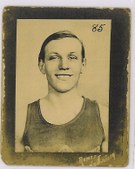
Romeo y. Julieta #85 Jimmy Wilde
|  313 313
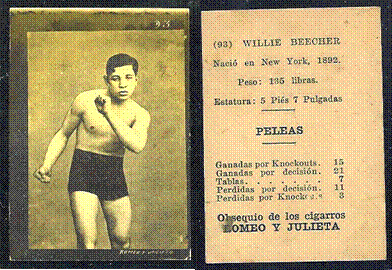
Romeo y Julieta Willie Beecher
|  314 314
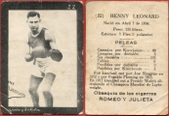
Romeo y Julieta Benny Leonard
|  315 315
A second version of the Leonard card, discovered in 2016.
|
 316 316
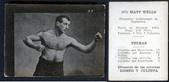
Jewish boxers were well represented in the RyJ set. Besides Leonard and Beecher, we have Matt Wells, Abe Goldstein, and Lew Tendler
|  317 317
|  318 318
|  319 319
|  320 320
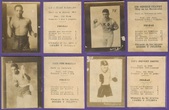
This and the next image are more Romeo y Julietas showing the variety of designs and image quality in the issue.
|  321 321
|  322 322
1920s Romeo y Julieta white variation
|
 323 323
|  324 324
1920s Romeo y Julieta white background with ring variety.
|  325 325
1920s Romeo y Julieta Sullivan v. Kilrain
|  326 326
|  327 327
|  328 328
|  329 329
|
 330 330
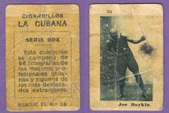
1920s Romeo y Julieta La Ciencia Del Boxeo. Another tobacco issue, this one showing 'how-to' boxing poses.
|  331 331
|  332 332
|  333 333
|  334 334
|  335 335
|  336 336
|
 337 337
|  338 338
|  339 339
|  340 340
|  341 341
|  342 342
|  343 343
|
 344 344
|  345 345
|  346 346
|  347 347
|  348 348
|  349 349
|  350 350
|
 351 351
|  352 352
|  353 353
1930 Chocolatin Mercedes Papke and Lewis. A very rare issue from Uruguay.
|  354 354
Papke and Lewis as they looked glued down.
|  355 355
This and the next photo show the Mercedes boxing series as it lays out on the album pages.
|  356 356
|  357 357
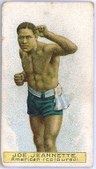
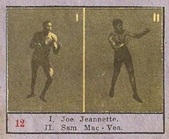
Jeannette and MacVea from the Mercedes set. These are counterfeits; South American sellers will often make photocopies or laser prints of partial sets and glue them into the album to give the impression of a complete set.
|
 358 358
E. Quintana issued a large series of boxing and baseball cards in 1931. The baseball cards include Martin Dihigo cards that sell for thousands. The boxers include Sixto Escobar and Pedro Montanez.
|  359 359
1931 Quintana back. There are a couple of varieties of backs depending on series of issue.
|  360 360
One of the Montanez fight cards, actually shows his opponent.
|  361 361
Two more Montanez cards
|  362 362
A Sixto Excobar card
|  363 363
|  364 364
One of the people shown is Pincho Gutierrez, who trained Kid Chocolate.
|
 365 365
1930s premium from a Cuban haberdashery w/HOFer Kid Chocolate.
|  366 366
1920s caramel wrapper from Argentina
|  367 367
1920s caramel wrapper from Argentina
|  368 368
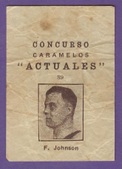
1920s caramel wrapper from Argentina
|  369 369
This is a mail response card used by Pathe to respond to fans who wrote to Jack Dempsey care of the studio.
|  370 370
This is the header card for a series of German transfer stamps depicting the 1927 Dempsey-Tunney fight.
|  371 371
16 of the 20 stamps
|
 372 372
|  373 373
ca. 1929 or 1930 E282 Goudey Oh Boy Gum Jack Dempsey and Tom Mix. From a series of 32 movie-related cards. One of the first Goudey cards.
|  374 374
A no-brand variation, recently discovered
|  375 375
A 1920s Hollywood still of Dempsey used to make the E282 Oh Boy card.
|  376 376
1920s French PC made from the same movie studio publicity still. From a global perspective, Dempsey was the most popular athlete in the world in the 1920s, proven by the many PCs of him from around the world.
|  377 377
|  378 378
|
 379 379
|  380 380
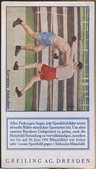
Three version of Greiling cards of Benny Leonard. Circa 1925-26. BTW, this one was stolen out of the mail en route to me, so if a postman tries to sell it to you, kick him hard in the testicles and contact me.
|  381 381
|  382 382
|  383 383
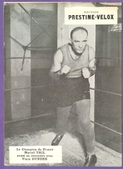
Prestine-Velox, a French cabinet card sized multisport set.
|  384 384
|  385 385
|
 386 386
|  387 387
|  388 388
|  389 389
|  390 390
|  391 391
|  392 392
|
 393 393
|  394 394
|  395 395
|  396 396
|  397 397
|  398 398
|  399 399
|
 400 400
|  401 401
|  402 402
|  403 403
|  404 404
|  405 405
|  406 406
|
 407 407
|  408 408
|  409 409
|  410 410
|  411 411
|  412 412
|  413 413
|
 414 414
|  415 415
|  416 416
|  417 417
|  418 418
|  419 419
|  420 420
1933 Goudey Sport Kings Max Baer. Goudey’s sole multisport issue depicts four fighters: Baer, Dempsey, Tunney and Carnera.
|
 421 421
Premium of Dempsey, Baer and Carnera from the Goudey Sport Kings issue. Scene from the MGM film The Prizefighter and the Lady.
|  422 422
ACC# R308 Tattoo Orbit Primo Carnera. Image from the MGM film The Prizefighter and the Lady
|  423 423
R308 Dempsey. Image from the MGM film The Prizefighter and the Lady
|  424 424
1930s Ray-O-Print Jack Dempsey
|  425 425
|  426 426
|  427 427
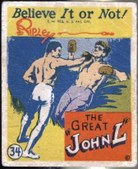
Loose-Wiles, the maker of Rippled Wheat cereal, issued a number of different items relating to Jack Dempsey in 1936 when he signed on as a national spokesman.
|
 428 428
|  429 429
|  430 430
|  431 431
|  432 432
ca. 1936 H-Unc. La Salle Hats cards. A set of 8 cards given in an envelope as a promotional device for haberdasheries.
|  433 433
This would be 7 of the 8 cards in the set plus an original envelope.
|  434 434
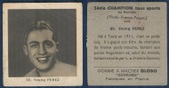
La Salle Hats Kid Lavigne
|
 435 435
|  436 436
1937 Kelloggs Pep Cereal Tommy Loughran
|  437 437
1937 Kelloggs Pep Cereal Jess Willard
|  438 438
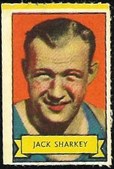
1937 Kelloggs Pep Cereal Jack Sharkey
|  439 439
1937 Kelloggs Pep Cereal Jack Delaney
|  440 440
1937 Kelloggs Pep Cereal James Corbett
|  441 441
|
 442 442
1930s Rogers & Peet Gene Tunney.
Issued by a haberdashery (clothing store) ca. 1930 in packs of 4, these blank-backed cards are quite difficult to find. Four boxers are featured: Tunney, Schmeling, Sharkey and Baer
|  443 443
In 1936-37 several newspapers, likely from a chain, issued stamps in pairs in their papers. They included boxers. They've gotten some respect lately as people realize that there are early cards of Joe DiMaggio and other stars in them.
|  444 444
There are two or more of the biggest names available. Sometimes found without the biography. Collected either way.
|  445 445
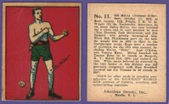
1938 NX5 #11 Kid McCoy. An ultra rare set issued in the American-occupied Phillippines just before the Japanese invasion. Supposed to be 250 cards; 40 are known. Most of them are shown here.
|  446 446
The wrapper from the set; only one I've ever seen. Sold on eBay years ago and never seen again. Note that the wrapper says 140 cards while the cards themselves say 250 cards/ .
|  447 447
1938 NX5 Joe Louis
|  448 448
1938 NX5 Benny Leonard
|
 449 449
1938 NX5 Al Brown
|  450 450
1938 NX5 Johnny Kilbane
|  451 451
1938 NX5 Tony Canzoneri
|  452 452
1938 NX5 Joe Gans
|  453 453
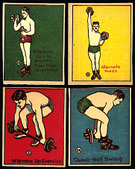
A few of the exercise cards.
|  454 454
|  455 455
|
 456 456
|  457 457
|  458 458
1942 Chicago Tribune Joe Louis, from a set of 70 WWII related strip cards issued in the newspaper with corresponding album.
|  459 459
1940s Coney lsland arcade card of Georges Carpentier. These cards were issued in Coney Island and sold only at that location. They are quite rare. I have seen a few of them offered over the years. The image was stolen from the Blue Boxers exhibit set.
|  460 460
1925 Blue Boxer Carpentier used to make the Coney Island card.
|  461 461
Coney Island Louis and Johnson. The pictures in the set were sourced from a variety of other issues and publicity photos.
|  462 462
An uncut sheet of the Coney Island cards. This is how they were distributed.
|
 463 463
|  464 464
|  465 465
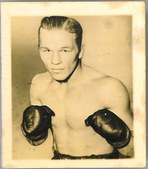
1948 Kellogg’s Pep Tony Zale is the sole boxer in this small, thin black and white cereal insert set.
|  466 466
|  467 467
reversed image of Zale from the Pep issue. There are also cropping variations.
|  468 468
1950 Bowman Wild Man Sullivan v. Kilrain
|  469 469
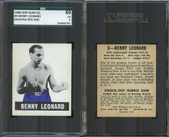
1948 Leaf Jack Dempsey. The 1948 Leaf boxing set is one of the two post-World War II boxing sets issued by a major gum manufacturer (the other is the 1951 Topps Ringside set) before 1990. It consists of 49 different cards, plus an unissued extremely rare Rocky Graziano (with fewer than ten known examples, most collectors do not even consider the Graziano to be part of the set).
|
 470 470
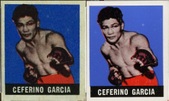
1948 Leaf Joe Louis. Printing quality is the biggest condition concern with 1948 Leaf cards. The card stock itself is fairly thick and holds up well, but the printing can vary from atrocious to breathtakingly nice. Front image registration is the single worst problem with the set. The set was printed in three passes -- black, red and blue – and relatively few of the cards actually align perfectly for all three phases. When the printing lines up exactly, the result is a crisp, sharp image and a very nice card indeed, but if any phase misses the mark by even a millimeter, the entire image is thrown off. Many collectors of this issue will sacrifice corner sharpness or centering to get a properly printed card. The card fronts also suffer from inking irregularities.
|  471 471
|  472 472
|  473 473
|  474 474
|  475 475
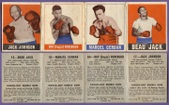
This four-card strip may be a salesman sample.
|  476 476
|
 477 477
|  478 478
|  479 479
|  480 480
|  481 481
|  482 482
|  483 483
|
 484 484
|  485 485
|  486 486
|  487 487
|  488 488
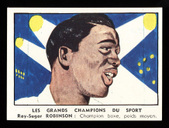
1951 Berk Ross Hit Parade of Champions (W532)Sugar Ray Robinson. This ugly multisport set was issued in boxed sets for sale directly to children in 1951, in four series. The cards came in two-card panels with a perforation between them.
|  489 489
1951 Ringside Abe Attell. This set was Topps’ sole full-fledged venture into the boxing market. The 1951 Ringside set was issued in two 48-card series. The second series is roughly twice as hard to find as the first series.
|  490 490
1951 Ringside Tiger Flowers. This card is very popular and sells for a considerable premium.
|
 491 491
1951 Ringside Barney Ross. Card fronts show a color image of the boxer (a painted photo called a “Flexichrome” was used) with the name and division in a box. The illustration quality varies with the quality of the source materials. Champions of the past have gold laurels surrounding a plate with the title and dates of title above the name. The present-day champions have a crown on the card.
|  492 492
1951 Ringside Gene Tunney. Card #95, Tunney is very tough to find. Although not short prints, two other cards are notorious problem cards: Joe Louis (#88) frequently has terrible centering left to right, and John L. Sullivan (#69) is often off-centered towards the bottom.
|  493 493
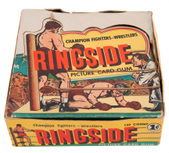
The Ringside box.
|  494 494
A two-card panel, sold in nickel packs.
|  495 495
An 8-card salesman sample. This one shows Marciano's rookie card.
|  496 496
The back of the sample panel.
|  497 497
1951 Arte y Deportes Juan Zurita from Mexico
|
 498 498
|  499 499
Kid Herman newsstand issue (1946-1970s): Issued in New York City by boxer Kid Herman, whose image appears on the back of the envelope in which they came. The set was sold originally in a packet for $0.25 at the Kid's newsstands and also peddled at Stillman's Gym, and was updated updated on different papers through the early 1970s. See my blog for more details.
|  500 500
Kid Herman Tommy Burns, original format printing
|  501 501
Over the next 20 years or so after the initial issue of the set, Herman reprinted the set and issued new cards for the new champs, in ever worsening quality. Interim reprints shifted from thin chipboard to heavier polished stock similar to Exhibit cards. The last printings were on a slick paper and weren't even sized consistently.
|  502 502
Kid Herman Jack Dempsey. Printed on thicker cardboard like an exhibit card, often mistaken for them. The earlier printings of Dempsey feature a different pose.
|  503 503
Kid Herman Schmeling
|  504 504
Kid Herman card of Jack Sharkey. The earlier printings of Sharkey feature a different pose.
|
 505 505
|  506 506
|  507 507
Joe Louis made after his retirement as the date "1946-" has been removed from the card.
|  508 508
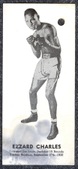
Kid Herman card of Ezzard Charles from a later printing. Trimmed down, probably a sample.
|  509 509
Kid Herman Walcott, also a trimmed down sample
|  510 510
Here is a Marciano card from a later printing.
|  511 511
Patterson Kid Herman card, later printing
|
 512 512
Here is the Sonny Liston from a later printing of the Kid Herman set.
|  513 513
The most elusive and valuable of the Kid Herman cards, printed post-Ali's 1967 loss of his belt and freedom for refusing induction into the army. Same pose as the 1960s Exhibit card.
|  514 514
|  515 515
|  516 516
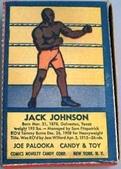
1950s Joe Palooka Benny Leonard. The back panel of a candy box.
|  517 517
Joe Palooka box.
|  518 518
|
 519 519
1947 Homogenized Bond Bread Marcel Cerdan. A short print, with La Motta.
|  520 520
The Homogenized Bond Bread card art was sourced from a variety of publicity photos of the era. Here is the Cerdan. The "deceased" notation is something that its former owner added to the piece.
|  521 521
This Cerdan is about 7 x 10 and comes from a multisport picture pack. It is often misidentified as a Homogenized Bond premium; really it is just the same art used for another product.
|  522 522
A Graziano from the picture pack. Not known as a Homogenized Bond Bread card.
|  523 523
A Primo Carnera from the picture pack; same image as on the Homogenized Bond card.
|  524 524
|  525 525
1951 Berk Ross Sugar Ray Robinson. One of six boxers in this two-card per panel multisport set, issued in boxed form.
|
 526 526
|  527 527
|  528 528
|  529 529
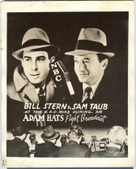
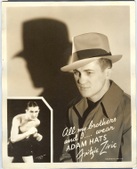
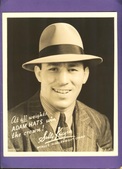
1930s Adam Hats premium, type 1. ACC designation H815.
|  530 530
1930s Adam Hats premium, type 2
|  531 531
|  532 532
|
 533 533
|  534 534
|  535 535
|  536 536
|  537 537
|  538 538
|  539 539
|
 540 540
|  541 541
|  542 542
|  543 543
|  544 544
|  545 545
|  546 546
|
 547 547
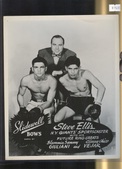
Another mens clothing issue, this one by Slidewell Bows, a tie-maker.
|  548 548
|  549 549
Now this is an interesting example of how a piece made for one purpose was reused. Bob Murphy's Slidewell Bows advertising piece had a new piece of copy stripped onto it to make this fight poster, which was then blown up and printed. Note the National studio logo at the bottom right that is not in the Slidewell ad piece.
|  550 550
|  551 551
Slim Jim was a brand of Slidewell Bows and several boxers were used to promote it.
|  552 552
|  553 553
|
 554 554
|  555 555
|  556 556
|  557 557
|  558 558
1951 Bread For Energy Billy Graham. I really like the proto-Pop Art designs of these labels.
|  559 559
1951 Bread For Energy Kid Gavilan
|  560 560
|
 561 561
|  562 562
1954 Brasserie Motte Cordonnier Laurent Dauthille. The issuer was a French brewery that sponsored a sweepstakes for a trip to its brewery in what was then French colonial Africa.
|  563 563
1954 Brasserie Motte Cordonnier Robert Cohen. Cohen was a world champion. I am absolutely certain on the ID of Dauthille and this one but the IDs of the fights in the ensuing images are tentative.
|  564 564
1954 Brasserie Motte Cordonnier Laurent Dauthille and Charles Humez
|  565 565
1954 Brasserie Motte Cordonnier Dauthille v. Young.
|  566 566
1954 Brasserie Motte Cordonnier Gavilan v. Humez
|  567 567
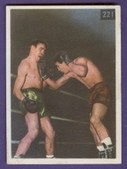
1954 Brasserie Motte Cordonnier Villemain v. Nardico
|
 568 568
1954 Brasserie Motte Cordonnier unknown--anyone got any ideas?
|  569 569
1955 Topps Hocus Focus Rocky Marciano small variety. One of the rarest Marciano cards.
|  570 570
1955 Topps Hocus Focus Archie Moore.
|  571 571
|  572 572
|  573 573
1962 Topps Great Americans John L. Sullivan.
|  574 574
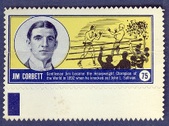
1962 Topps Great Americans Jim Corbett
|
 575 575
This is a 1927 or slightly later set of transfers issued by a German company commemorating the Dempsey-Tunney "Long Count" title fight.
|  576 576
Matchcover from Primo Carnera's liquor store in Glendale, California.
|  577 577
Tony Canzoneri died in 1959, so his autographs are not easy. This is the only signed exhibit of his I've ever seen.
|  578 578
Beau Jack signed exhibit card. Jack was "discovered" shining shoes in Miami hotels as an older man and became a fixture on the autograph circuit after that.
|  579 579
1940s snapshot of Jim Jeffries Barn in Burbank, California, site of many local bouts.
|  580 580
1950 Safe-T Manuel Ortiz. A Washington DC area regional issue, and very rare.
|  581 581
Barney Ross signed contract for 1951 Topps Ringside cards. Ross, a true American hero, was a 3-division champ and won the Silver Star for battlefield heroics on Guadalcanal.
|
 582 582
OK, it isn't even remotely a card. It is, however, a cool boxing collectible. This slug is a trade stimulator for Jim Jeffries' pool hall and bar in Los Angeles.
|  583 583
OK, it isn't a boxing card, but come on, I'm only human. Julie Newmar...
|  584 584
1930s Lucky Heart Co. Joe Louis premium.
| 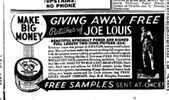 585 585
Advertisement for Lucky Heart Co. offering the Louis premium, from The Chicago Defender newspaper on June 5, 1937. Thanks to collector Arthur Rich for his research in finding this ad.
|  586 586
1935 Brown & Bigelow Joe Louis premium
|  587 587
A variation with a caption. Also 1935.
|  588 588
Brown & Bigelow also made fans using the Louis artwork, and sold them to various businesses for use as promotional products.
|
 589 589
|  590 590
|  591 591
|  592 592
|  593 593
|  594 594
|  595 595
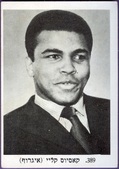
An Israeli "Cassius Clay issue from the late 1960s. Blank backed and on thin paper.
|
 596 596
|  597 597
|  598 598
|  599 599
|  600 600
|  601 601
|  602 602
|
 603 603
|  604 604
|  605 605
1967 Crack Campeones Cassius Clay.
|  606 606
1967 Crack Campeones
|  607 607
|  608 608
|  609 609
|
 610 610
|  611 611
|  612 612
|  613 613
|  614 614
|  615 615
|  616 616
|
 617 617
|  618 618
|  619 619
|  620 620
|  621 621
|  622 622
|  623 623
|
 624 624
|  625 625
|  626 626
|  627 627
|  628 628
|  629 629
|  630 630
|
 631 631
|  632 632
|  633 633
|  634 634
|  635 635
|  636 636
|  637 637
|
 638 638
|  639 639
|  640 640
|  641 641
|  642 642
|  643 643
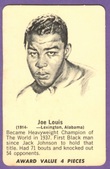
The Joe Louis puzzle from the board game
|  644 644
A few years ago a set of cabinet sized cards was discovered. The art on some of the cards differs from the art on the regular cards. Perhaps a prototype or proof set?
|
 645 645
|  646 646
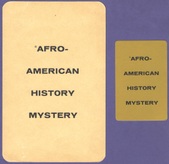
Box cover for the board game, copyrighted 1969, with the players using the yellow cards. The red cards were issued later.
|  647 647
|  648 648
|  649 649
|  650 650
|  651 651
|
 652 652
|  653 653
|  654 654
|  655 655
|  656 656
|  657 657
|  658 658
|
 659 659
|  660 660
|  661 661
|  662 662
|  663 663
|  664 664
|  665 665
|
 666 666
|  667 667
|  668 668
|  669 669
|  670 670
|  671 671
|  672 672
|
 673 673
1972 Ases Del Ring [Mexico] Saldivar, Napoles, Ramos and Olivares
|  674 674
|  675 675
|  676 676
|  677 677
|  678 678
|  679 679
|
 680 680
|  681 681
|  682 682
|  683 683
|  684 684
|  685 685
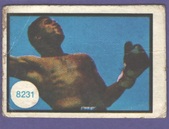
1975 Malaysian issue Ali
|  686 686
1975 Malaysian issue Ali
|
 687 687
|  688 688
1975 Malaysian issue Ali
|  689 689
|  690 690
|  691 691
|  692 692
|  693 693
|
 694 694
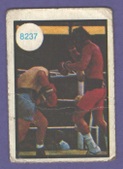
1975 Malaysian issue scene from Ali-Foreman
|  695 695
1975 Malaysian issue Foreman
|  696 696
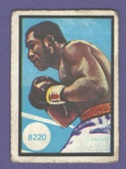
1975 Malaysian issue Ken Norton
|  697 697
|  698 698
|  699 699
|  700 700
|
 701 701
|  702 702
|  703 703
|  704 704
|  705 705
1935 Pattreiouex Joe Louis
|  706 706
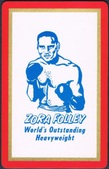
1938 Churchman's Joe Louis
|  707 707
|
 708 708
|  709 709
|  710 710
|  711 711
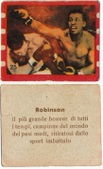
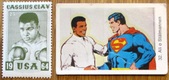
1965 Swedish Candy Clay
|  712 712
|  713 713
|  714 714
|
 715 715
|  716 716
|  717 717
|  718 718
|  719 719
|  720 720
|  721 721
|
 722 722
|  723 723
|  724 724
|  725 725
|  726 726
|  727 727
|  728 728
|
 729 729
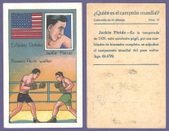
1959 or 1960 German card of a September 1959 match between Bubi Scholz and Johnny Halafihi
|  730 730
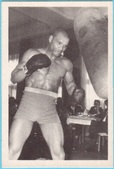
1962 German card of Harold Johnson issued as he arrived in Germany to fight a title match with Bubi Scholz.
|  731 731
|  732 732
|  733 733
|  734 734
|  735 735
|
 736 736
|  737 737
1952 Cicogna
|  738 738
1954 Rover
|  739 739
|  740 740
1958 SADA Firenze
|  741 741
1959 Hokus Fokus (Germany) Sugar Ray Robinson
|  742 742
1964 Chocolat Simon (Spain) Griffith-Paret.
|
 743 743
|  744 744
|  745 745
|  746 746
Can't say exactly when issued but definitely pre-1959 since that was the year he died and the signature is good.
|  747 747
|  748 748
|  749 749
|
 750 750
|  751 751
|  752 752
|  753 753
|  754 754
|  755 755
|  756 756
|
 757 757
|  758 758
|  759 759
|  760 760
1973 Panini Roberto Duran RC.
|  761 761
|  762 762
|  763 763
|
 764 764
|  765 765
|  766 766
|  767 767
1981 Gong Salvador Sanchez RC. A Japanese issue, from a full page insert in the magazine.
|  768 768
1981 Gong Alexis Arguello RC. From sticker sheets in the magazine.
|  769 769
1981 Gong Tommy Hearns RC, predating his Panini by a year.
|  770 770
|
 771 771
|  772 772
1982 Panini Wilfredo Gomez RC
|  773 773
1986 Panini
|  774 774
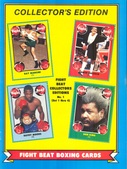
1983-84 Fight Beat Magazine cards. This quartet was issued in the December 1983 mag, which was the premiere edition of the publication. Mancini, Rosario and King are RCs.
|  775 775
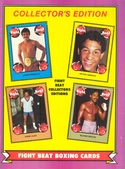
1983-84 Fight Beat Magazine. Camacho RC.
|  776 776
1983-84 Fight Beat Magazine
|  777 777
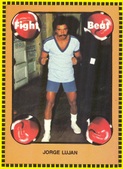
1983-84 Fight Beat Magazine
|
 778 778
1984 Fight Beat Hector Camacho RC
|  779 779
1984 Fight Beat
|  780 780
1984 Fight Beat
|  781 781
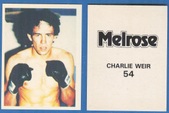
1984 South African cheese (really) card.
|  782 782
|  783 783
|  784 784
|
 785 785
1987 Panini Julio Cesar Chavez RC
|  786 786
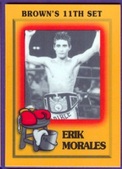
1990 Browns Hector Camacho
|  787 787
|  788 788
1991 Ringlords Holyfield prototype. I like this one better than the actual card.
|  789 789
1991 Kayo sample card
|  790 790
1991 Kayo regular issue Emmanuel Steward. Got it signed in person at the Lewis-Klitschko presser. Nice guy; he corrected the typos on the card, front and back.
|  791 791
1991 Kayo certified autographed insert card.
|
 792 792
|  793 793
1992 Classic Oscar De La Hoya. Check out the cheesy 'stache on the Golden Boy.
|  794 794
1991 Classic Muhammad Ali, signed version. One of the early signed insert cards.
|  795 795
|  796 796
|  797 797
|  798 798
|
 799 799
1994 Browns Johnny Tapia RC
|  800 800
|  801 801
|  802 802
|  803 803
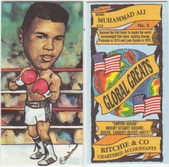
1994 Global Greats Ali. A regional issue from the UK, this version from an accounting firm. There are also constabulary (police) versions.
|  804 804
|  805 805
1994 Tetrad Larry Holmes signed insert card
|
 806 806
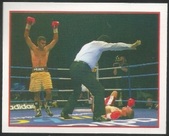
1996 Merlin Sky Sport Prince Naseem Hamed
|  807 807
1996 Merlin Sky Sport Nigel Benn
|  808 808
1996 Merlin Sky Sport Frank Bruno
|  809 809
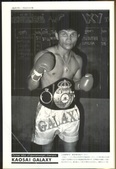
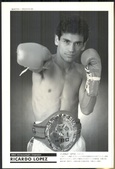
1996 Ringside. Rookie card.
|  810 810
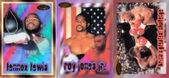
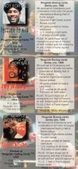
1996 Ringside promos
|  811 811
1996 Ringside promos, card backs
|  812 812
|
 813 813
|  814 814
|  815 815
|  816 816
|  817 817
|  818 818
|  819 819
|
 820 820
|  821 821
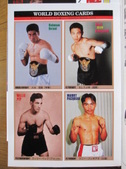
1997 World Boxing Magazine Bernard Hopkins. Again, part of the 4 card insert, this is also a RC, preceding his Brown's card by a year.
|  822 822
1999 World Boxing Magazine. For several years the magazine issued cards in four card insert panels in the magazine. WBM issued a number of good rookie cards but they really caught lightning in a bottle with the Pacquiao card, widely considered to be his RC. Top quality examples can reach four figures.
|  823 823
Better look at Pac-Mans RC
|  824 824
2001 Ukrainian calendars of the Klitschko brothers.
|  825 825
2002 Question of Sport (UK)
|  826 826
|
 827 827
| 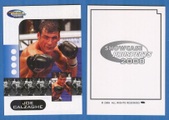 828 828
| 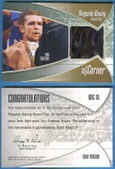 829 829
|  830 830
|  831 831
2012 Leaf National Ali
|  832 832
2012. Tecate made a true boxing card for Pacquiao-Marquez 4. Fits right into standard holders, even has stats. I hope they make this style of card regularly.
|  833 833
2012 Panini Adrenalyn Anthony Joshua.
|
 834 834
2013 Leaf National Roy Jones Jr.
|  835 835
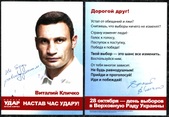
This card and the next are from Vitali Klitschko's Ukraine political campaign.
|  836 836
|  837 837
|  838 838
2015 Leaf National Mike Tyson. Made of acetate. Clear background
|  839 839
|  840 840
|
 841 841
|  842 842
|  843 843
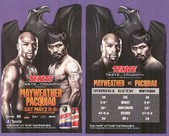
2015 Tecate Mayweather-Pacquiao card. The fight was a dud but the card Tecate made is a beautiful die cut double sided card about the size of a 1952-56 Topps card.
|  844 844
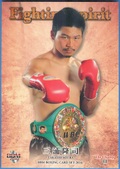
2016 BBM Fighting Spirit (Japan)
|  845 845
2016 BBM Fighting Spirit (Japan)
|  846 846
2016 BBM Fighting Spirit (Japan)
|  847 847
2016 BBM Fighting Spirit (Japan)
|
 848 848
|  849 849
|  850 850
|  851 851
2016 Boxing Ringwalk Songs. A UK issue created as a promotion of a CD compilation of music. 27 cards in all, very limited issue sent to music industry insiders, the first 50 online buyers of the CD and occasionally given away by the record company in contests.
|  852 852
|  853 853
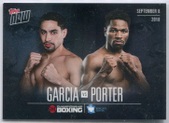
2016 Vegas Outlaws Don King.
|  854 854
|
 855 855
|  856 856
|  857 857
|  858 858
|  859 859
|  860 860
|  861 861
|
 862 862
|  863 863
|  864 864
|  865 865
|  866 866
|  867 867
|  868 868
|
 869 869
|  870 870
|  871 871
|  872 872
|  873 873
|  874 874
|  875 875
|
 876 876
|  877 877
|  878 878
|  879 879
|  880 880
|  881 881
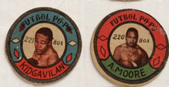
1959 Futbol Po-Po (Argentina)
|  882 882
|
 883 883
|  884 884
|  885 885
|  886 886
|  887 887
|  888 888
|  889 889
|
 890 890
|  891 891
|  892 892
|  893 893
|  894 894
|  895 895
|  896 896
|
 897 897
|  898 898
|  899 899
|  900 900
|  901 901
|  902 902
|  903 903
|
 904 904
|  905 905
|  906 906
|  907 907
|  908 908
|  909 909
|  910 910
|
 911 911
|  912 912
|  913 913
|  914 914
|  915 915
|  916 916
|  917 917
|
 918 918
|  919 919
|  920 920
|  921 921
|  922 922
|  923 923
|  924 924
|
 925 925
|  926 926
|  927 927
|  928 928
|  929 929
|  930 930
|  931 931
|
 932 932
|  933 933
|  934 934
|  935 935
|  936 936
|  937 937
|  938 938
|
 939 939
|  940 940
|  941 941
|  942 942
|  943 943
|  944 944
|  945 945
|
 946 946
|  947 947
|  948 948
|  949 949
|  950 950
| |
